Showing posts with label ipaded. Show all posts

Wednesday, 19 February 2014

iBeacon Technology in Education

New technology providing a beacon for learning

In most schools the students need to find the resources, and access the learning. This is often a complex, frustrating and time consuming process. What would happen if the learning found the students? Welcome to Learning Zones and iBeacons in Education.

Watch Video HERE: 

iBeacon technology in Education

I love new technology and making connections with student learning. When I heard about iBeacon technology I jumped at the opportunity and started making plans. These included purchasing a set of Estimote Beacons and working with the creative Kurt from Vektor Digital in the States to create a prototype that would explore the capabilities of iBeacon technology in an educational context. Having extensively explored the benefits of Augmented Reality in Education for the past two years, I was excited about the possibilities that iBeacon technology would bring to the education sector and schools throughout the world. I wasn't disappointed with the results!


So I started exploring/planning the concept of "learning zones", geographical positions located around school where students could go to learn and explore online learning experiences. I discovered that the iBeacon technology actually found the students (as they walked throughout the campus) through instant notifications and digital prompts. This excited me as this was the first time that the learning found the students instead of the students having to navigate the complexities of elearning portals and confusing Intranets. 


The students receive a notification as they pass by a "learning zone", and the follow up activity on the EduBeacons App, similar to that of the beloved children's game "Hot and Cold", drawing on the students inquiry based natural instincts.

Our 3 Learning Zones include:
  1. The Library Learning Zone where students are instantly given video book reviews.
  2. The Technology Learning Zone where students run through a series of video tutorials to teach them the basics of coding.
  3. The Art Learning Zone where students can create master pieces through video tutorials custom made by our Art Teacher.
There are other possibilities within a school context that will be explored.

Beacons that:
  1. Welcome Parents when they enter the schools gates and prompt them to explore the school calendar and daily events.
  2. Give warning to turn their phone to silent when they enter a performance centre.


This is just the beginning of this technology and I have no doubt others with improve on my work in the educational field quickly and effectively. For now I'm content in the knowledge that true edtech magic happens through a persons imagination, skill (thanks Kurt) and global collaboration! These are the 3 qualities we should be prioritizing in schools throughout the world!

Keep innovating.

Paul

Saturday, 28 December 2013

Don't underestimate the teacher in the edtech classroom

Just recently with a year 4 class I introduced a project involving

"creating a digital game using the App Hopscotch".

It was a magnificent project with our students learning many things, including higher level thinking skills. I designed the project, demonstrated the basic skills of the hopscotch App and made sure I had lots of opportunities for students to collaborate with each other.


Watching this was amazing. The unit was basically running itself. I decided to conference some students who I thought were struggling and run some sessions with them.

At the end of the unit it was time for each student to show me their game, and receive a mark based on the detailed criteria. What did I discover?

Those students I conferenced with did far better than my tech savvy students. See we all know the importance of feedback and goal setting. The students who I conferenced with did just that. They were able to identify issues, problems with their learning and set goals and identify students and adults in the class who could help their learning. This doesn't come natural to the students and needs to be fostered and encouraged. I can't think of an App that individualises learning for young students like this!

We should never understand the importance of the teacher. As Hattie states (through his extensive research) Teachers are still the most important element in a child's learning!

Yes students can learn independently, but we should never fall into the habit of assuming technology (or the App) will teach our students. The teacher brings about taking the learning to the next level and this should never be forgotten.

My coding tutorials on YouTube can be found:
http://www.youtube.com/watch?v=E8BMVDk3VSQ&list=PLprciURrC7Fu86bqB5P4nO3GjVuY5RVx4

Paul

About Paul:
2013 Finalist - International EdTech Digest Awards Recognition Program honoring tools, trendsetters and leaders in the education and technology sector. The distinguished awards program recognizes outstanding solutions―and the best and brightest minds―in education and technology.

2013 Finalist - EduBlogs Life Time achievement award.

Apple Distinguished Educator Class of 2013. Paul is a leader in the implementation of Augmented Reality in schools to improve learning outcomes, Professional Development of staff with integration of ICTs, and has expertise in the implementation of mobile devices into pedagogical frameworks.

Creator
The Tellagami Project (Presentation)
Teaching students to code on the iPad (iBook)
Augmented Reality in Education (iBook) 
10 Amazing lessons for the iPad Classroom (iBook)
Formative Feedback for Learning and Science AR (Apps)

"Paul, you are a real Leader" - Dr Heidi Hayes Jacobs, author and internationally recognized education leader known for her work in curriculum mapping, curriculum integration and developing 21st century approaches to teaching and learning.
"Paul we designed iBooks Author to be a tool that teachers could use to create content that they develop for the classroom and can share with the world. It is great Paul that you have been using it that way to great success." - Philip Schiller - Apple’s Senior Vice President of Worldwide Marketing.


Friday, 8 November 2013

Hour of Code just the beginning

With the momentum building in the lead up to Computer Science Week in the States and Hour of Code, I can't help thinking this is just the beginning. What makes me think this? For the past 12 months I have been teaching my students to Code and I have seen the benefits first hand. Rich, deep level thinking, the collaboration, and the ability to see Code come alive are just some of the reasons all students should learn to code in schools.

On the 9th December (and the lead up week) there is a massive push to get kids coding. I think the success of this week and what follows is dependent on an element we have not placed a higher enough priority on - the teachers. See without passionate teachers who believe in coding we will not produce passionate students. The teacher is not the only ingredient, but certainly an important one.

Paul is the Author of the upcoming iBook "Teaching students to code on the iPad".


Sunday, 27 October 2013

3 awesome iPad Apps to get kids coding

The language of Code is a universal language. We use technology almost every minute of everyday and yet we remain ignorant of how technology actually works. What drives this technology? Code!

With iPads being so popular in schools across the globe what are some iPad Apps that will get kids coding around the world.

1.Daisy the Dinosaur

Description

Learn the basics of computer programming with Daisy the Dinosaur! This free, fun app has an easy drag and drop interface that kids of all ages can use to animate Daisy to dance across the screen. Kids will intuitively grasp the basics of objects, sequencing, loops and events by solving this app's challenges. After playing Daisy, kids can choose to download a kit to program their own computer game.


2.Hopscotch

Description


Hopscotch works by dragging and dropping blocks of code. Build little routines and press play to see your code in action! As you get more advanced, you can add more objects and run your code using events like shaking and tilting the iPad or even shouting at the iPad! We were heavily inspired by MIT's Scratch.

Many of the best coders fell in love with programming as kids at the age of 8, 10 and 12 years old. With Hopscotch, kids can build and perfect their own creations while obtaining an understanding of the fundamentals of computer science.

3. GamePress

Description


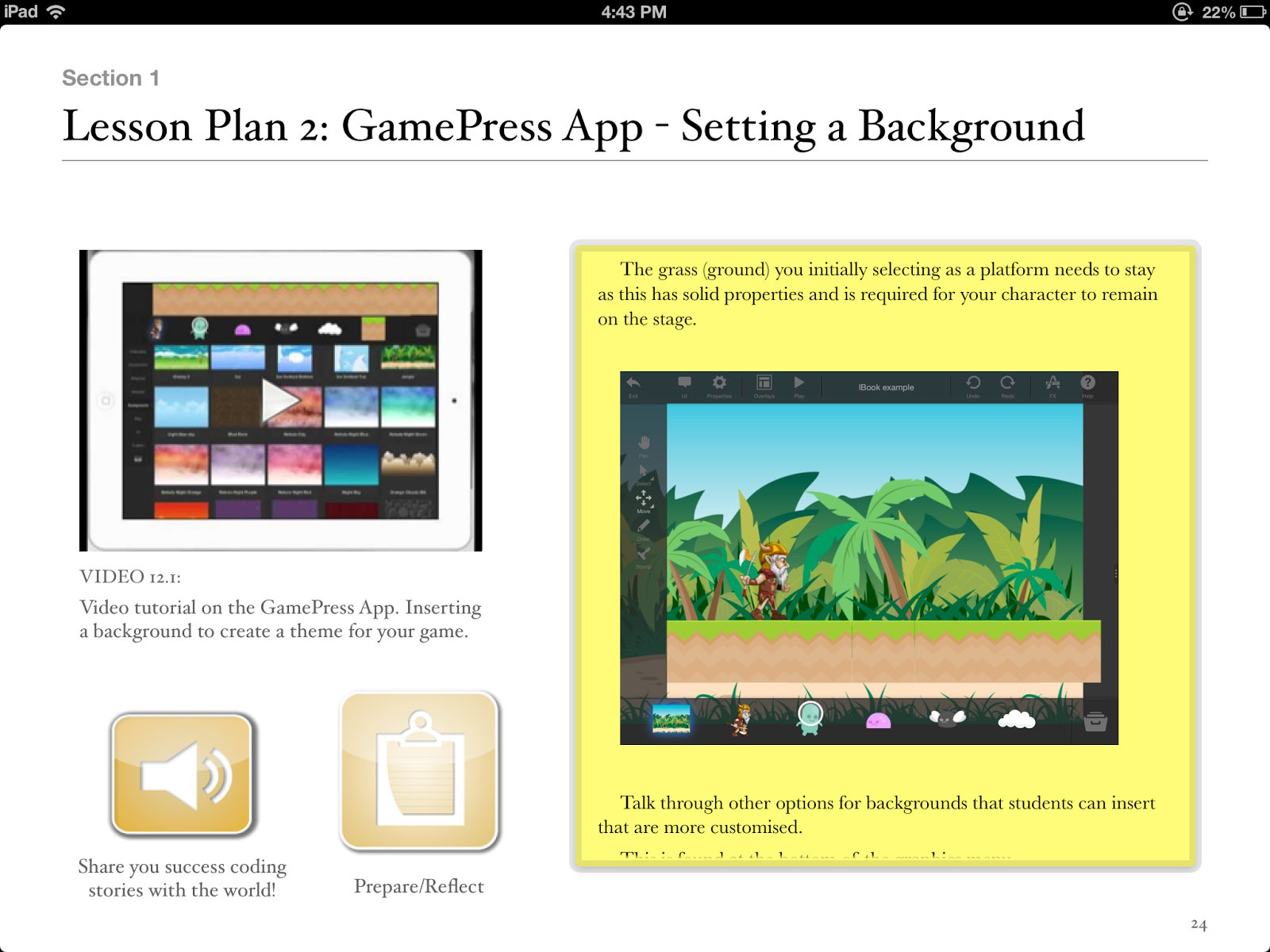
Teachers, you can make use of GamePress to teach students about game design, logic and even computer science and engineering! The no programming interface makes learning complex concepts fun and easy. Games have become more than just a way to pass time, they’re perfect for education and learning new things.


Paul is the author of Teaching students to code on the iPad .


Paul is a:

2013 Finalist - International EdTech Digest Awards Recognition Program honoring tools, trendsetters and leaders in the education and technology sector. The distinguished awards program recognizes outstanding solutions―and the best and brightest minds―in education and technology.

Apple Distinguished Educator Class of 2013. Paul is a leader in the implementation of Augmented Reality in schools to improve learning outcomes, Professional Development of staff with integration of ICTs, and has expertise in the implementation of mobile devices into pedagogical frameworks.

Creator
The Tellagami Project (Presentation)
Teaching students to code on the iPad (iBook)
Augmented Reality in Education (iBook) 
10 Amazing lessons for the iPad Classroom (iBook)
Formative Feedback for Learning and Science AR (Apps)

"Paul, you are a real Leader" - Dr Heidi Hayes Jacobs, author and internationally recognized education leader known for her work in curriculum mapping, curriculum integration and developing 21st century approaches to teaching and learning.
"Paul we designed iBooks Author to be a tool that teachers could use to create content that they develop for the classroom and can share with the world. It is great Paul that you have been using it that way to great success." - Philip Schiller - Apple’s Senior Vice President of Worldwide Marketing.

PUBLIC SPEAKING EXPERIENCE

Guest Speaker - Best Apps for Kids - State Library Queensland 2013
National Leading a Digital School Conference - 2013 (Melbourne)
Augmented Reality in Education
21st Century Skills v Technology

IWB Interactive Teaching and Learning Conference - Sydney 2012
The benefits of teaching game design and strategy.
Technology and Formative Assessment strategies.

Thursday, 26 September 2013

3 things students should be doing on iPads

My primary job is advising and coaching teachers to use technology in effective ways in classrooms. iPads as a technological tool in classrooms is a major part of this job. Researching effective Apps, encouraging teachers to look for connections between the curriculums and integration of these amazing devices are just 2 aspects of my job that are both challenging and incredible rewarding.

So, what are some things our students should be doing on iPads? Here are some thoughts.

1). Authoring and Publishing digital content.
Utilising Apps such as Book Creator, allows students to become authors and publishers. With a little research there is nothing stopping students publishing to the world! iBooks continues to be an under utilised App in schools.


2). Creating Multi-Modal Presentations.
Using an App like Explain Everything, students can now present and demonstrate knowledge in a variety of ways. Students who struggle with literacy can show teachers through videos and audio that there is a wealth of knowledge they have and want to share.


3). Learning to Code.
Using Apps like Hopscotch and GamePress, students can create and publish digital games and learn the language of Code at the same time. With a little structure, students can collaborate with others so that lessons are not teacher centred, allowing students to spread their wings and learn at an appropriate rate.


Paul


About Paul Hamilton, Author of this Blog:

2013 Finalist - International EdTech Digest Awards Recognition Program honoring tools, trendsetters and leaders in the education and technology sector. The distinguished awards program recognizes outstanding solutions―and the best and brightest minds―in education and technology.

Apple Distinguished Educator Class of 2013. Paul is a leader in the implementation of Augmented Reality in schools to improve learning outcomes, Professional Development of staff with integration of ICTs, and has expertise in the implementation of mobile devices into pedagogical frameworks.

Creator
The Tellagami Project (Presentation)
Augmented Reality in Education (iBook) 
10 Amazing lessons for the iPad Classroom (iBook)
Formative Feedback for Learning and Science AR (Apps)

"Paul, you are a real Leader" - Dr Heidi Hayes Jacobs, author and internationally recognized education leader known for her work in curriculum mapping, curriculum integration and developing 21st century approaches to teaching and learning.
"Paul we designed iBooks Author to be a tool that teachers could use to create content that they develop for the classroom and can share with the world. It is great Paul that you have been using it that way to great success." - Philip Schiller - Apple’s Senior Vice President of Worldwide Marketing.

PUBLIC SPEAKING EXPERIENCE

Guest Speaker - Best Apps for Kids - State Library Queensland 2013
National Leading a Digital School Conference - 2013 (Melbourne)
Augmented Reality in Education
21st Century Skills v Technology

IWB Interactive Teaching and Learning Conference - Sydney 2012
The benefits of teaching game design and strategy.
Technology and Formative Assessment strategies.

Saturday, 17 August 2013

Let's get our little students learning to code

Let's get little ones learning to code. Get them off these so called educational Apps and let them experience the magic of programming and making the characters on our iPad react to our commands. Follow up with older learners with Hopscotch App and GamePress App!
http://youtu.be/mqo9K4Dw31M


Saturday, 10 August 2013

When the teacher gets in the way of learning

Do students learn differently than we did? Absolutely.

Sometimes I feel I am holding them back as a teacher, and this feeling was never more prevalent than this afternoon with my own daughter Rachel. In Year 7 she saw me creating some online tutorials about a new App called GamePress. It is an App that allows students to create their own games and learn to code at the same time.

learning to code


I allowed her to sit down on the iPad and follow my instructions/tutorials on Youtube at http://www.youtube.com/user/appsbypaulhamilton/videos

Before I knew it she was learning in a way that illustrated the power of the flipped classroom and the power of video instruction in the younger generations.

Let's keep an open mind teachers: